Description
Product Details
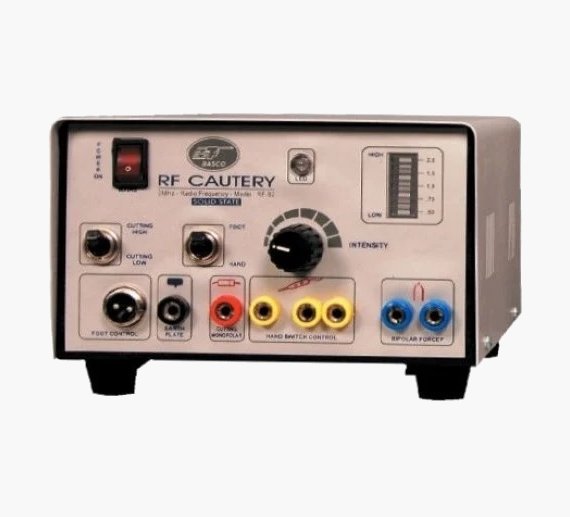
→ Application: Hospital
→ Frequency: 2 MHz
→ Power Input: 220 volts +-5%
→ Power Consumption: 150 Watts
→ Dimension: 8 1/2 X 7 1/2 X 4 Inch
Standard Accessories :
→ Monopolar Handle 1No.
→ Patient plate 1No.
→ Electrodes Set 1No.
→ Foot Switch 1No.
→ Carrying Case 1No.
→ Hand Switch 1No.
→ Bipolar Cable 1No.
→ Bipolar Forcep 1No.
Specification :
→ Power input 220 volts +-5%
→ Power consumption 150 Watts
→ Frequency 2 MHz
→ Maximum Output
→ HF Monopolar 150Watts on 400 ohm load
→ HF Bipolar 100 Watts on 100 ohm load
→ Fulguration 100 Watts on 1000 ohm.
→ Size: 8 1/2″ X 7 1/2″ X 4″
→ Weight: 3.5 Kgs
Various Application of RF cautery for Dermatology :
→ Adenoidectomy
→ Laryngeal Disorders
→ Keloid Surgery
→ Nasal Polypectomy
→ Nose Bleeding
→ Removal of Ranula Cyst
→ Snoring
→ Tonsil and Adenoid
→ Tonsil tumor
→ Wart, Nevus Skin Tumor
→ Adenoidectomy
→ Nasal Mucosa
→ Nasal Polypectomy
→ Nasal Tumor
→ Procedure Of Snoring
→ R.F. of Palate
→ Tosillectomy
→ Turbinate